


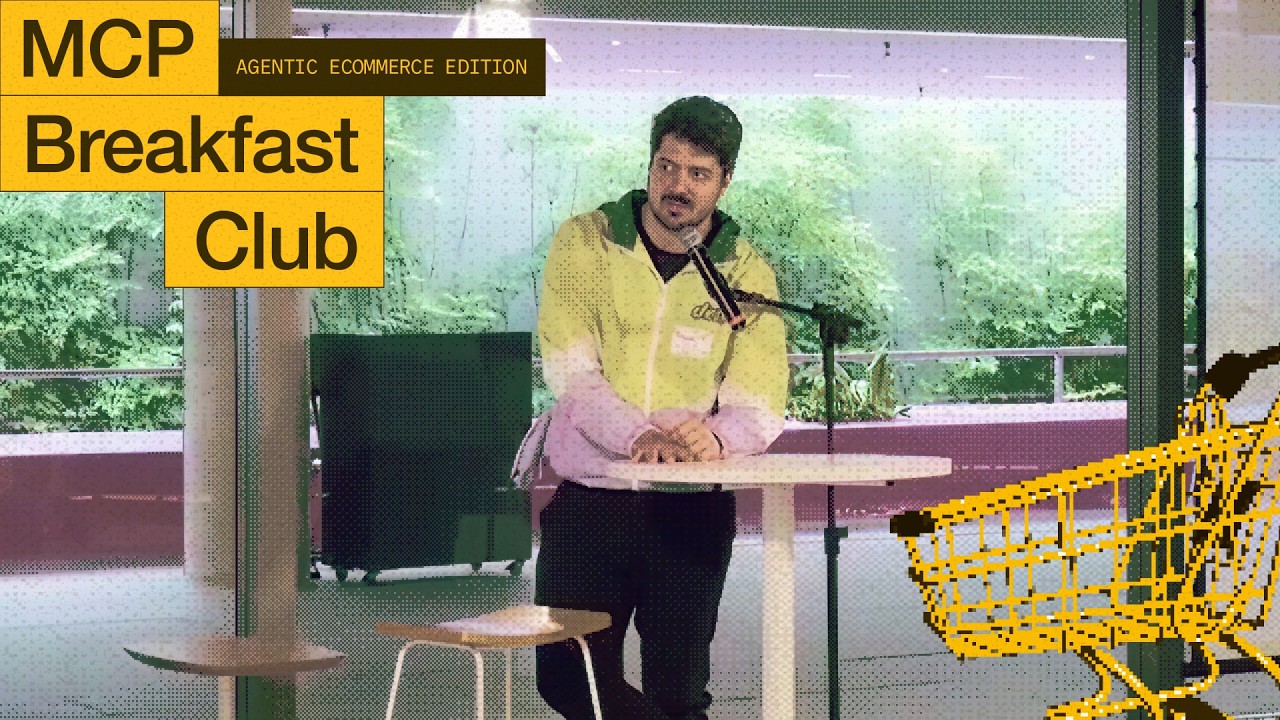
On February 25, we hosted the first MCP Breakfast Club at Casa Alice in São Paulo. Engineers and technical leaders from across Brazilian e-commerce joined in person and remotely for a morning of talks and discussion about running MCP in production.
Three speakers presented on how MCP has evolved and where it's going, how to build autonomous agent loops for storefronts, and what MCP governance looks like inside a large retail company. Here's a summary of each.
The State of MCP: From Read-Only to Building Blocks
Camudo (Viktor Marinho), deco
Camudo opened with context engineering: the idea that the most important work right now is making your company's context (data, processes, business rules, task state) available to machines. Not waiting for a smarter model. Making the context you already have accessible.

That's where MCP fits in. Anthropic launched it in late 2024 as an open spec for connecting LLMs to tools. At first, people used it locally: plug a documentation source into your code editor and let the model read it. But MCP kept evolving. Remote transport via HTTP. OAuth. Write operations. UIs served through MCPs. The ChatGPT Apps SDK from OpenAI formalized the pattern of delivering tools and interfaces together.
REST / OpenAPI
- Documentation optional in practice
- Discovery requires extra setup
- Every integration is ad hoc
MCP
- Documentation mandatory and built-in
- Discovery is part of the protocol
- One standard from LLMs to code to UIs
That single constraint, making docs and discovery mandatory, is a big part of why adoption spread. And once you take MCP seriously as infrastructure, the patterns get interesting. MCPs start behaving like building blocks: you can compose multiple servers into one (virtual MCPs), treat them as swappable interfaces (bindings), wire them into event-driven systems (an event bus), and generate typed RPC clients from their schemas to call APIs directly from code.
Every company will have an MCP layer. SaaS tools as MCPs, departments as MCPs, even people as MCPs. The protocol is just over a year old. The patterns are still forming.
He also demoed MCP Mesh, an open-source control plane deco built to centralize MCPs with auth, monitoring, and governance.
Centralizing MCPs and Building Agent Loops for E-Commerce
Guilherme Rodrigues, CEO, deco
Guilherme picked up where Camudo left off, but from the angle of someone applying these ideas in production. deco operates 100+ e-commerce storefronts and is responsible for their SLA. The question he started with: how do you monitor, diagnose, and optimize that many sites without scaling your team linearly?
His answer was to invest in an MCP layer first and build agents on top of it. You start by exposing your internal systems (observability, CDN data, analytics, code repositories) as MCP servers and centralizing them in a gateway. Once you have that catalog of tools, building new agents becomes a composition exercise: pick the tools, write a prompt, define when it runs.

He emphasized that each new agent reuses the infrastructure you already built, and that workflows should be written as code (not drag-and-drop), so you get version control, tests, and regular development tooling. To illustrate the pattern, he walked through a few agents the team has been building:
The point across all three: once your company's capabilities are available as MCPs, you can compose them into agents, chat interfaces, admin UIs, and direct code integrations. The same tool serves all four consumers.
Open-source repos shared during the talk:
- storefront-skills: domain knowledge for e-commerce agents
- mcps: open-source MCP servers (HyperDX, ClickHouse, and more)
- mesh: MCP gateway and control plane
MCP Governance in Retail and the Road to UCP
Enio Moraes, Consultant, Movimento AI
Enio brought a different angle: a consultant who helped a large retail company go from chaotic AI adoption to a governed MCP platform. The starting point was messy. Employees were using free ChatGPT, DeepSeek, and Claude with no data controls. Someone accidentally sent a voucher to the wrong email list. Credentials were hardcoded. MCP servers were installed without review.

The fix was built in stages. First, centralization: LibreChat (open source) deployed in a private VPC as the company's internal AI platform, with three curated LLMs available to roughly 500 employees. Then governance, in two layers:
Before: no controls
- Free ChatGPT, DeepSeek, Claude used without oversight
- MCP servers installed without security review
- Credentials hardcoded, no rotation
- Accidental voucher sent to wrong list
After: governed platform
- Approved MCP catalog reviewed by engineering + security
- RBAC per MCP function (data engineer vs analyst)
- Audit trails, cost dashboards, real-time alerts
- Dedicated team supervising platform and usage
Enio connected this work to UCP (Universal Commerce Protocol), the open standard from Google, Shopify, Target, and Walmart for agent-to-agent commerce. His point: companies with a governed MCP layer today will be ready when UCP arrives.
Recurring Themes Across the Three Talks
Different speakers, different contexts, but a few ideas kept surfacing:
MCP goes beyond chat
Autonomous agents, event-driven automation, typed API layers. If your mental model is still "plug docs into my IDE," there's a lot more to explore.
Governance matters early
Enio's retail case showed what happens without access control or audit trails. It gets expensive fast.
The investment compounds
Centralize your MCPs and codify domain knowledge. Every new agent builds on existing infrastructure. The third one is faster than the first.
E-commerce is a strong fit
Structured data, well-defined operations, measurable feedback loops. Good conditions for MCP-powered agents to prove their value.
This was the first MCP Breakfast Club. Stay tuned for the next edition.


